
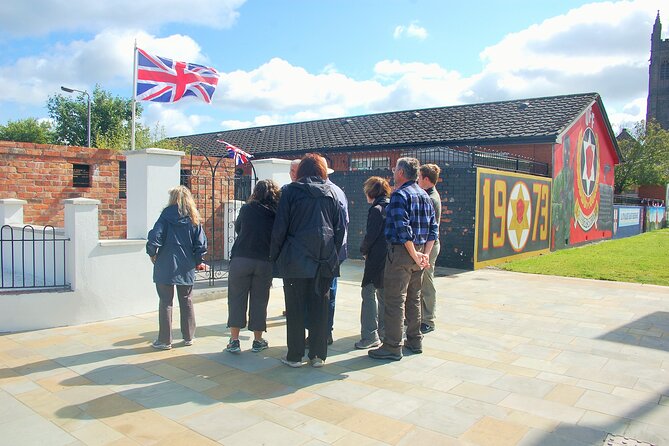
Reviewed · BLACK TAXI TOURS
1 Hour Express Belfast Taxi/Cab Tour History, Murals, Troubles
One hour can change how Belfast looks. This private black-cab tour links Falls Road, the Peace Wall, and Shankill Road, giving you a quick but serious introduction to the divisions that shaped Northern Ireland. I like the private format, since your group can ask questions without sharing the cab with strangers. I also like the chance to hear from a local taxi driver, someone who may explain the Troubles through lived experience rather than a standard script.
The main drawback is the short running time. You get about 25 minutes in the Falls Road area, 10 minutes at the Peace Wall, and 25 minutes around Shankill Road, so this is an introduction, not a full study of Belfast’s past. At $89.45 per person, it makes the most sense for you if your time is tight or if you want a personal first look at the city’s political murals and communities.
In This Review
- Key points before you book
- Why this short Belfast tour works
- Falls Road, Bobby Sands, and the marks of conflict
- The Peace Wall and a divided city
- Shankill Road and loyalist Belfast
- The value of a local taxi driver
- What $89.45 per person buys you
- Who should book this experience?
- Final verdict: book it for a personal first look
- FAQ
- How long does the Belfast taxi tour last?
- What places does the tour visit?
- Is this a private tour?
- Where does the tour start?
- Where does the tour finish?
- What language is the tour offered in?
- Is food or drink included?
- Can I cancel or change my booking?
Key points before you book
- A private cab for your party: You do not share the vehicle with other groups, which makes sensitive questions easier to ask.
- Three places explain Belfast’s divisions: Falls Road, the Peace Wall, and Shankill Road show different sides of the city’s political story.
- Local drivers lead the tour: The strongest part may be the personal account of life during the Troubles, especially with a guide such as Brendan.
- The tour takes about one hour: The compact schedule works well before or after other Belfast plans.
- Central pickup is available: Pickup is included from most centrally located Belfast hotels, with the Leonardo Hotel Belfast listed as the meeting point.
- The price pays for privacy and access: At $89.45 per person, value depends on how much you want direct conversation and a private vehicle.
Why this short Belfast tour works
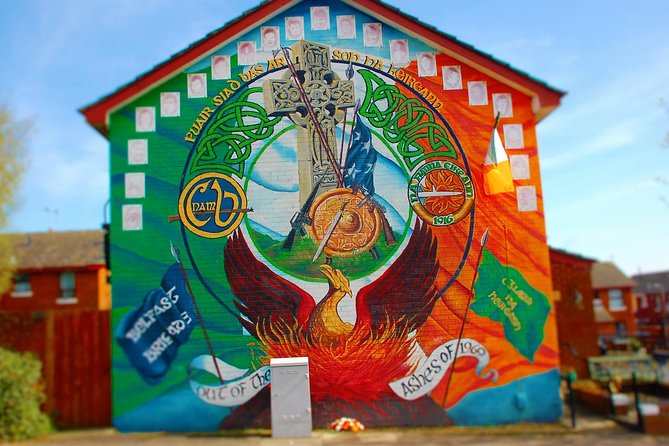
Belfast’s political story is not confined to a museum. It is painted on walls, marked by barriers, and tied to streets where Catholic nationalist and Protestant unionist communities lived close together but often on separate sides of a divide.
That is why a taxi tour can be useful. The vehicle takes you between places that are not far apart geographically but carry very different identities. You are not simply looking at murals. You are being shown how streets, communities, and political loyalties fit together.
The tour is private, so your party can set the tone. You might want a broad introduction, or you might have specific questions about the murals, the peace process, or daily life during the Troubles. A local driver can also explain the difference between what you see on the wall and how the area functions as a living community today.
The published score is 5.0 from 17 responses, with 100 percent recommending the experience. That is a small sample, but the praise points to a clear strength: the guide’s personal knowledge. One particularly strong response names Brendan and describes his experience growing up during the Troubles. That kind of first-hand perspective can give the hour more meaning than a purely factual drive-by tour.
More black taxi tours in Belfast:
- Cab Tours Belfast Famous Black Taxi Tours
★ 5.0 · 3,633 reviews - Private Black Taxi Belfast City Tour
★ 5.0 · 2,188 reviews - Belfast’s Political Mural Taxi Tour
★ 5.0 · 1,180 reviews
Falls Road, Bobby Sands, and the marks of conflict
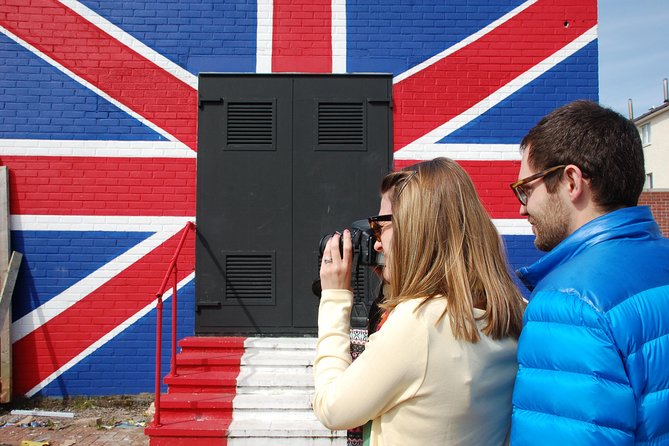
The first major section focuses on West Belfast, especially Falls Road and the Divis area. This is the part of the tour where you begin to see how Irish republican identity is expressed through public art and local landmarks.
The Falls Road is a predominantly Catholic and nationalist part of Belfast. During the Troubles, it became closely linked with the Provisional IRA, formed in 1969 after a split within the IRA. The area had already been shaped by Irish republican politics, cultural activity, economic hardship, and tension with nearby loyalist districts.
One of the most striking details is the Falls Road Library. Its exterior still carries bullet holes connected with gun battles involving British Army forces. The building’s damage is a physical reminder that the conflict was not an abstract political argument. It reached into ordinary streets and public buildings.
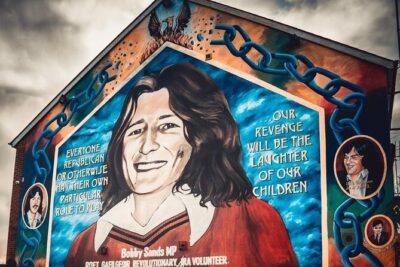
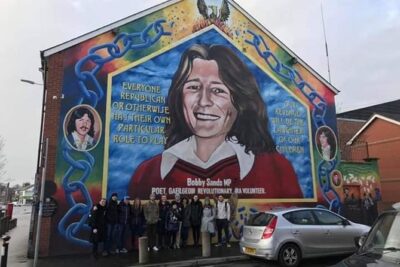
Directly opposite is the Bobby Sands mural, one of Belfast’s best-known political murals. It shows Sands, an IRA member who died during the 1981 hunger strike while imprisoned in the H-Blocks. For the republican movement, he became a symbol of resistance. For others, his connection with the IRA makes the mural part of a more difficult and contested story.
The mural includes Sands’s line about revenge being the laughter of children. That idea points toward a future beyond conflict, but the image remains political. Your guide may help you understand why such a mural can be read as both memorial and statement.
I appreciate that this section gives you more than a quick photograph. You can look at the art, then connect it to the history of Falls Road, the library, the hunger strike, and the wider republican cause. The limitation is time. Twenty-five minutes is enough to see key sights and hear an explanation, but not enough to examine every mural or debate every point of view.
You should also approach the area with respect. These are not stage sets built for sightseeing. The streets are part of a working community, and the murals relate to grief, identity, prison, and political violence. Listen carefully, ask questions politely, and avoid treating the subject as a novelty.
The Peace Wall and a divided city
The Peace Wall section lasts about 10 minutes. That may sound brief, but the wall is one of the clearest places to understand Belfast’s physical divisions.
Peace Walls were first built in 1969, during the early years of the Troubles. They were intended as temporary barriers between mainly Catholic nationalist areas and mainly Protestant unionist areas. Instead, many remained in place and expanded over the decades.
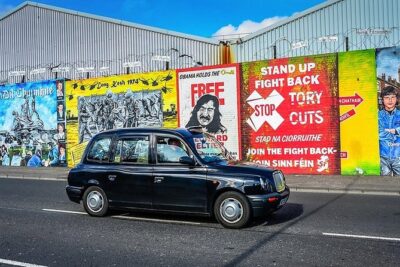
The barriers vary in form. Some are fences, while others are substantial concrete structures topped with steel, barbed wire, or gates. Their purpose was to reduce violence between communities, but their continued presence also shows how difficult it has been to build trust.
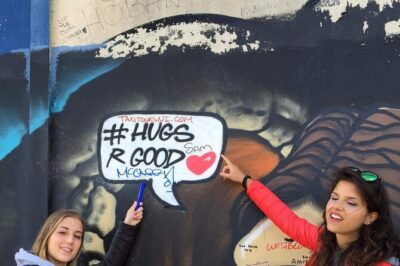
You are invited to sign your name on the wall. That is a memorable part of the experience, though I would treat it as a small personal gesture rather than the main point of the stop. The important thing is to understand what the wall represents: separation, fear, protection, and the unfinished work of peace.
Ten minutes is enough for a short explanation and a look at the structure. It is not enough for a long walk along the wall or a detailed account of every gate and mural. If you want extensive time here, this tour may feel rushed. If you want a clear introduction between the two main communities, the stop does its job.
The Peace Wall also helps connect the first and third sections. Falls Road shows the republican and nationalist side of Belfast. Shankill Road shows the loyalist and unionist side. The wall sits between those identities, both literally and politically.
Shankill Road and loyalist Belfast
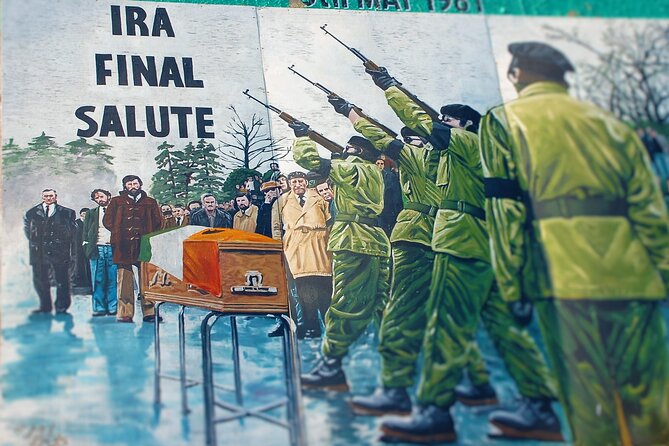
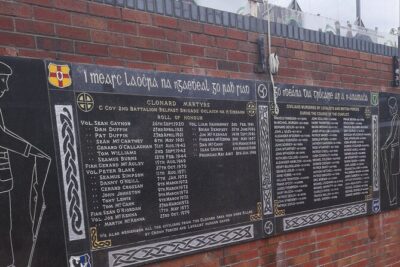
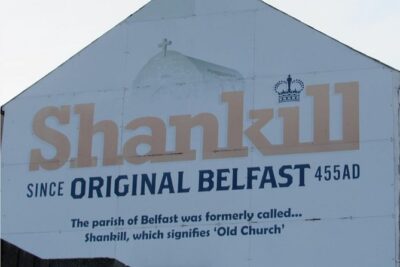
The final 25-minute section visits Shankill Road, a predominantly working-class, Protestant, unionist, and loyalist area. Its murals and political symbols reflect a different set of loyalties from those found on Falls Road.
Shankill Road is linked with loyalist paramilitary groups, particularly the Ulster Volunteer Force and the Ulster Freedom Fighters. These organizations played important roles in loyalist paramilitary activity during the Troubles. Seeing this side of the story matters because a tour of Belfast should not present the conflict as belonging to only one community.
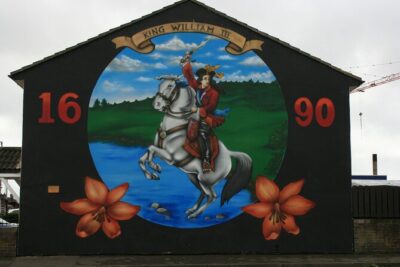
The contrast with Falls Road is one of the tour’s greatest strengths. On one side, you encounter Irish republican symbols and the memory of Bobby Sands. On the other, you see loyalist political imagery and references to British identity. The short distance between the two areas makes Belfast’s division easier to understand.
I would pay close attention to the driver’s wording here. Murals often present a community’s own version of events. They can honor dead fighters, mark political victories, or express loyalty to a national identity. A good explanation helps you separate the image’s message from the broader history.
This stop receives the same 25-minute allocation as Falls Road, which is sensible. You get enough time to look around and compare the two districts, but you should not expect a full walking tour of Shankill Road.
The subject can be uncomfortable, and that is part of its value. Belfast’s past involved sectarian violence, paramilitary groups, military forces, imprisonment, hunger strikes, and civilian fear. The tour is most useful when it helps you hold more than one perspective at once.
More mural and peace wall tours in Belfast:
- Belfast Troubles Tour: Walls and Bridges
★ 5.0 · 853 reviews - Famous 1.5 hour Belfast Murals Tour
★ 5.0 · 477 reviews - Belfast Political Tour-Conflicting Stories Walking Tour
★ 4.5 · 459 reviews - Belfast Murals Taxi Tour
★ 5.0 · 341 reviews
The value of a local taxi driver
The guide is central to this experience. You are not simply paying for transport between three locations. You are paying for conversation, context, and a chance to hear how the conflict affected ordinary life.
The strongest published praise focuses on Brendan, who grew up as a child during the Troubles. That detail matters. A guide with personal memories may explain what it felt like to live through the period, not just when the main events happened or which group controlled a particular street.
You should remember that personal accounts are personal. One driver cannot represent every Catholic, Protestant, nationalist, unionist, republican, or loyalist experience. Still, direct recollection can make the past easier to understand, especially when paired with the visible evidence around you.
Because the tour is private, you can ask for clarification without worrying about holding up a larger group. You can also ask the driver to explain a mural or political symbol that you do not recognize. That private setting is especially useful for a subject where a rushed question can lead to confusion.
The provider’s response to the praise also names Aoife, who thanks the customer for supporting the company and its guides. That confirms the operator places strong emphasis on its drivers and the personal side of the tour.
What $89.45 per person buys you
At $89.45 per person, this is not the cheapest way to see Belfast. You are paying for a private activity, an air-conditioned vehicle, a local guide, and pickup from most centrally located hotels.
The price becomes easier to justify if you are traveling as a small private party and want a direct conversation. A shared tour may cost less, but it would not give you the same control over questions or pace. If you are alone, the per-person cost may feel high for only one hour.
The tour includes a mobile ticket and is offered in English. Food, drinks, and other refreshments are not included. The listed inclusions also mention a free pic, though the exact meaning of that item is not explained, so I would not book based on it.
The meeting point is the Leonardo Hotel Belfast on Great Victoria Street, and the activity ends back at the meeting point. Pickup from most centrally located Belfast hotels is included, so check your hotel location when booking rather than assuming every address qualifies.
Departure times are flexible enough for you to choose a time that fits your day. That makes the tour easy to place before dinner, after arriving in Belfast, or between other central activities.
The booking is non-refundable and cannot be changed for any reason. If the operator cancels because the minimum number of participants has not been reached, you are offered another date or experience, or a full refund. Since you cannot alter the booking after purchase, choose your time carefully.
Who should book this experience?
I would recommend this tour to you if you want a focused introduction to Belfast’s political past and prefer a private setting. It suits couples, families, and small groups who want to ask questions and hear a local account without committing to a longer excursion.
It is also a good choice if you have only one day in Belfast. The route covers the three most important areas named in the tour, and the one-hour format leaves room for museums, food, shopping, or other sightseeing.
Families can participate, but children must be accompanied by an adult. Most people can take part, and the tour operates near public transportation. The vehicle is air-conditioned, which adds comfort even though the ride is short.
I would hesitate if you want a slow walking experience, long stops, or a detailed political lecture. You may also prefer another option if you want to avoid emotionally difficult subjects. The Troubles are not presented as distant folklore here. The murals and wall connect directly to violence and community memory.
Final verdict: book it for a personal first look
Book this Belfast taxi tour if you value a local voice, privacy, and a clear route through the city’s divided past. The Falls Road and Bobby Sands mural show republican memory, the Peace Wall makes separation visible, and Shankill Road adds the loyalist side of the story.
Skip it if $89.45 feels too high for one hour or if you want to spend more time at each location. For everyone else, the compact schedule is useful, and the chance to speak with a driver who may have lived through the Troubles gives the experience its real value.
FAQ
How long does the Belfast taxi tour last?
The tour lasts approximately one hour. The planned stops allow about 25 minutes around Falls Road and Divis, 10 minutes at the Peace Wall, and 25 minutes on Shankill Road.
What places does the tour visit?
The tour visits the Falls Road and Divis area, the Peace Wall, and Shankill Road. The Falls Road section includes the Falls Road Library and the Bobby Sands mural.
Is this a private tour?
Yes. Only your group participates in the activity, so you do not share the tour with other groups.
Where does the tour start?
The listed meeting point is the Leonardo Hotel Belfast on Great Victoria Street, Belfast BT1 6DY. Pickup from most centrally located Belfast hotels is included.
Where does the tour finish?
The activity ends back at the meeting point.
What language is the tour offered in?
The tour is offered in English.
Is food or drink included?
No. Drinks, food, and drinks are not included in the tour price.
Can I cancel or change my booking?
No. The experience is non-refundable and cannot be changed for any reason. If the operator cancels because the minimum number of participants is not met, you are offered another date or experience, or a full refund.
More 1-Hour Experiences in Belfast
- Private 1 Hour Belfast Taxi cab Tour
★ 5.0 · 81 reviews - History of Belfast conflict and terror 1 hour black taxi tour
★ 5.0 · 7 reviews
More History Tours in Belfast
- A History of Terror – Belfast City Centre Walking Tour
★ 5.0 · 2,883 reviews - Private Political History & Murals Tour Belfast
★ 5.0 · 182 reviews - Belfast Political/history/troubles private taxi/cab tour
★ 5.0 · 69 reviews - Belfast by the Glass: alternative history of Belfast, sip by sip.
★ 5.0 · 9 reviews
Just added around Belfast
- Belfast City Airport (BHD) to Belfast Accommodation – Arrival Private Transfer★ 5.0 · 3 reviews
- Belfast history of terror & mural 1 hr express private taxi tour★ 5.0 · 3 reviews
- Game of Thrones scene location inc Giants causeway from Belfast★ 5.0 · 3 reviews
- Belfast Private Walking Tour with a Local★ 3.0 · 3 reviews
- Experience the Antrim Coast and the Land of Giants – Private Tour★ 5.0 · 3 reviews
- Giants Causeway Tour From Belfast including Game of thrones sites★ 5.0 · 3 reviews
- Belfast to Dublin Transfer★ 5.0 · 3 reviews
- Private Coast Tour in Belfast★ 5.0 · 3 reviews
Black Taxi Tours, compared.
Browse the lists this tour appears in