
Reviewed · BLACK TAXI TOURS
Peace Wall Taxi Tour
Belfast’s past is still painted on its walls. This private taxi tour makes that difficult history easier to understand, taking you from the Bobby Sands mural to Shankill Road and both sides of the Peace Wall. I like the flexible route, which lets you ask questions and request stops, and I like the chance to hear a local guide explain both Irish Nationalist and British Unionist views. The main drawback is that the quality of the experience may depend heavily on your assigned driver, and one critical account found the guide less focused on the Troubles than expected.
The tour lasts about one to two hours and costs $55.56 per person. That is fair value for a private vehicle, hotel or city pickup options, several stops, and a guide who can explain the conflict in personal terms. Still, you should know that this is a taxi tour, not necessarily a traditional black-cab tour, and the vehicle may be a plain taxi or older minivan.
In This Review
- Key points to know before booking
- Why a private taxi works well in Belfast
- Bobby Sands mural and the Nationalist story
- Shankill Road and the Unionist point of view
- Seeing both sides of the Peace Wall
- Passing Crumlin Road Gaol
- The guide makes or breaks the experience
- Price, timing, and practical value
- Who will appreciate this Belfast tour
- Should you book the Peace Wall Taxi Tour?
- FAQ
- Where does the Peace Wall Taxi Tour start?
- Where does the tour finish?
- How long does the tour last?
- How much does the tour cost?
- Is the tour private?
- Which locations are included?
- Is the itinerary flexible?
- Is the tour offered in English?
- What is the cancellation policy?
Key points to know before booking
- Hear both sides of the Troubles: The route covers Irish Nationalist and British Unionist areas without treating one community as the whole story.
- Visit the Bobby Sands mural: This is the clearest introduction to the Nationalist cause and its powerful symbols.
- Cross between two communities: You see the Peace Wall from both sides and learn why it remains in place.
- Ask for a personal route: The itinerary can change according to your questions and interests.
- Dan or Danny may be your guide: The strongest experiences come from his firsthand stories of growing up in Belfast.
- Plan around the short duration: The tour is compact, so it gives you a focused introduction rather than a complete study of Northern Ireland’s conflict.
Why a private taxi works well in Belfast
The Troubles can feel confusing when reduced to dates, political labels, and wall murals. A private taxi gives you a moving classroom, with the useful advantage that you can interrupt, ask for clarification, and spend more time on subjects that matter to your group.
This is especially helpful if you are visiting Belfast with children or older relatives. Several accounts describe Dan as patient with children, including youngsters aged 7, 12, and 15. One family appreciated that he offered pens so the children could write on the Peace Wall and spoke kindly with a boy who was about to begin secondary school.
The private format also means only your own group takes part. You do not have to worry about strangers dominating the discussion or a fixed group schedule. Pickup is available anywhere in Belfast and the surrounding area for an additional charge, and the tour can drop you wherever you need within Belfast. That can save time if you are fitting the experience between other plans.
The advertised operating hours are 8 a.m. to 8 p.m., Monday through Sunday. The listed meeting point is Belfast city centre, though pickup arrangements can be made elsewhere. Confirmation is provided at booking, and mobile tickets are accepted.
More black taxi tours in Belfast:
- Cab Tours Belfast Famous Black Taxi Tours
★ 5.0 · 3,633 reviews - Private Black Taxi Belfast City Tour
★ 5.0 · 2,188 reviews - Belfast’s Political Mural Taxi Tour
★ 5.0 · 1,180 reviews
Bobby Sands mural and the Nationalist story
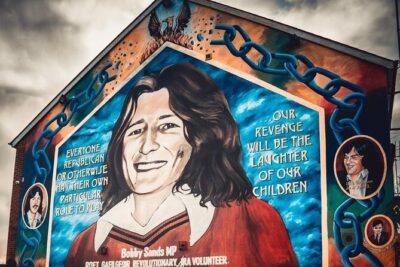
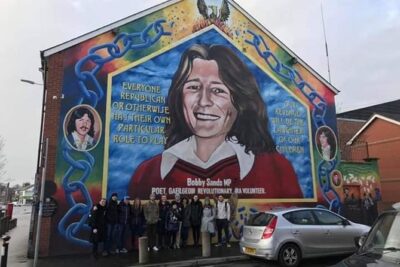
The first main stop is the Bobby Sands mural, with about 30 minutes set aside. Admission is free, and the value comes from the explanation rather than a ticketed attraction.
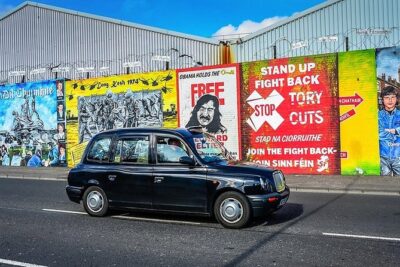
Bobby Sands was an Irish Republican figure who died on hunger strike in 1981 while imprisoned. His mural on the Falls Road area has become one of Belfast’s best-known political images. You will not simply be looking at street art. You will be looking at a symbol of Republican identity, memory, sacrifice, and resistance to British rule.
A good guide helps you understand why the image means different things to different people. For some, Sands represents a political prisoner and a demand for Irish self-determination. For others, he was connected to an armed campaign that caused suffering and death. The point of this stop is not to hand you a tidy answer. It is to show how a mural can function as history, memorial, and political statement at the same time.
The guide’s personal connection matters here. Dan is described as someone who grew up in Belfast during the Troubles, and his stories are one of the main reasons this tour appeals to people seeking more than a textbook account. You may hear about what ordinary life felt like, how communities were divided, and how the conflict affected families.
Expect the material to be serious. The tour can include stories of violence, imprisonment, loss, and fear. Dan’s style has also been described as warm and occasionally touched with black humor, which can make difficult subjects easier to discuss. That tone will not suit every group, but it may feel more human than a polished, formal lecture.
Shankill Road and the Unionist point of view
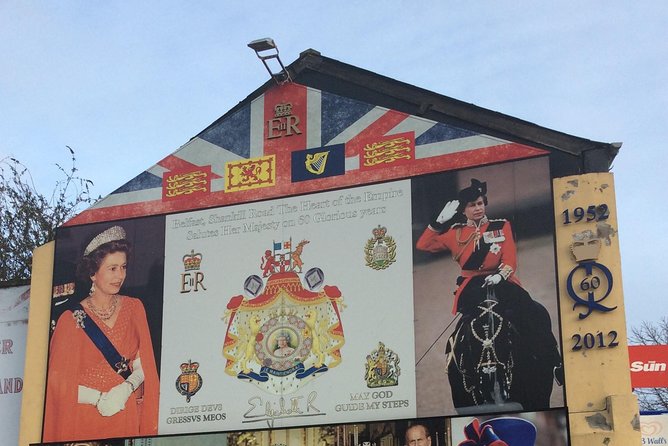
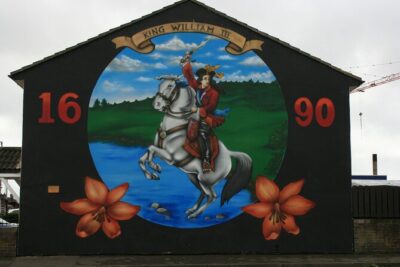
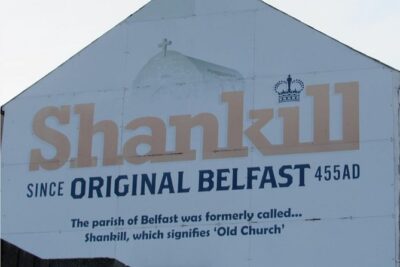
The next stop is Shankill Road, also planned for roughly 30 minutes. This area is associated with the British Unionist and Loyalist community, so it provides the necessary counterpoint to the Falls Road and Bobby Sands mural.
Here, you learn why many residents identify strongly with the United Kingdom and regard British identity as central to their political and cultural life. Murals in the area reflect loyalty to Britain, local organizations, military connections, and memories of people killed during the conflict. Again, the art is not decoration in the usual sense. It records how a community sees itself.
This part of the route is important because Belfast’s political murals can tempt you into choosing a side before you understand the fears behind each position. The tour tries to explain both communities in plain language. You can ask about flags, symbols, religion, political allegiance, and the way the conflict shaped neighborhoods.
The guide’s neutrality is a major selling point, but keep your expectations sensible. No account of the Troubles is entirely detached from personal experience. A guide who lived through the period will have memories and opinions. The best approach is to listen closely, ask respectful questions, and recognize that firsthand storytelling offers insight without being the only version of events.
One positive feature is the lack of rush. The taxi can stop at places of interest, giving you time to get out, take photographs, and talk through what you are seeing. Rain is common in Belfast, and Dan has been praised for arriving with umbrellas and offering to take photographs. Those small touches matter when you are standing outside beside political murals.
Seeing both sides of the Peace Wall
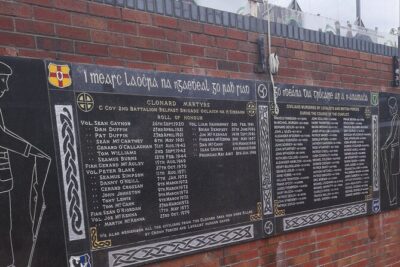
The Peace Wall is the emotional centre of the tour. You are taken to both sides of the barrier and hear how each community understands its purpose.
The walls and gates were built to reduce contact and violence between Nationalist and Unionist neighborhoods. They are called Peace Walls, but they also show that the peace process did not erase the divisions. Some gates have historically opened and closed at set times, and one account describes the gates shutting in the evening and reopening in the morning. The precise arrangements can vary, but the larger point remains: Belfast’s peace is real, yet physical separation still plays a role.
You can write on parts of the wall, and children may find this a memorable way to take part. The act is simple, but it can lead to a useful conversation about what peace means after conflict. A message on the wall is hopeful, personal, or political, depending on who writes it.
The guide explains the wall from both sides instead of presenting it as a single tourist photo stop. From one side, the barrier can be viewed as protection. From the other, it can feel like a daily reminder of separation. This is where the tour’s local perspective has the most impact.
The experience may also raise uncomfortable questions about the present. You might hear about continued tensions, community identity, and the fact that peace does not mean every disagreement has disappeared. One particularly thoughtful idea from the tour is that an imperfect peace is better than a perfect war. It is a useful way to understand why a structure that looks sad and unnecessary can still be regarded by some residents as practical.
Give yourself time to look beyond the photograph. Notice the height of the wall, the messages, the gates, and the way nearby homes sit beside a political boundary. You do not need a long lecture to feel the weight of the place, but a guide’s context prevents it from becoming just another backdrop for a selfie.
More mural and peace wall tours in Belfast:
- Belfast Troubles Tour: Walls and Bridges
★ 5.0 · 853 reviews - Famous 1.5 hour Belfast Murals Tour
★ 5.0 · 477 reviews - Belfast Political Tour-Conflicting Stories Walking Tour
★ 4.5 · 459 reviews - Belfast Murals Taxi Tour
★ 5.0 · 341 reviews
Passing Crumlin Road Gaol
The final listed stop is Crumlin Road Gaol, with about 10 minutes devoted to passing the former prison and hearing stories about people who spent time there.
The gaol is closely tied to Belfast’s political past. Prisoners connected with different sides of the conflict were held there, and the building carries stories of executions, escapes, imprisonment, and political violence. This tour does not include a full prison visit. You pass the building and hear selected stories from outside or from the vehicle.
That short stop is useful as a closing piece because it connects the murals and neighborhoods to the prison system. The people represented on walls were not abstract political figures. Many were arrested, detained, or killed, and Crumlin Road Gaol helps place those events in a physical setting.
The limitation is clear: ten minutes is not enough for a full examination of the gaol. If you want to explore the prison itself, you will need to arrange a separate visit. On this taxi tour, treat it as a brief historical reference rather than a major attraction.
The guide makes or breaks the experience
The most praised guide is Dan M, sometimes referred to as Danny in the comments. His strengths are described in consistent terms: warm, frank, patient, personal, and willing to answer difficult questions.
His firsthand account of growing up in Belfast is the feature that gives the tour its emotional force. He can connect political events to everyday life, then relate Belfast’s experience to conflicts elsewhere in the world. Families have especially valued his ability to explain hard subjects in ways children can follow.
Dan also appears to be generous with practical help. He has accommodated delayed arrivals, accepted a Christmas Eve booking, returned an item left in the vehicle, and helped with photographs in bad weather. Those details suggest a guide who treats the outing as a personal service rather than a simple drive between stops.
There is one important caution. One dissatisfied customer felt the tour moved away from the Troubles and spent too much time on wider political and religious subjects, including current events in Gaza and Christian themes. The response from the operator acknowledged the criticism. If you want a tightly controlled historical tour, say so at the start and ask your guide to keep the focus on Belfast.
Another criticism compared this experience unfavorably with traditional black-cab tours. The distinction matters. A black-cab tour may offer a more established format, while this experience is a private taxi ride shaped more by the individual driver. That flexibility can be a strength or a weakness.
Price, timing, and practical value
At $55.56 per person, the value depends on the size of your group. For one or two people, the cost is higher than a large group tour, but you are paying for a private experience, vehicle transport, flexible questions, and the ability to choose your drop-off point.
For a family or small group, the price becomes easier to justify. You avoid arranging separate transport between the Falls Road, Shankill Road, Peace Wall, and Crumlin Road. You also gain a guide who can adapt explanations to children, older relatives, or people with limited background knowledge.
The route takes about one to two hours. The listed stop times add up to about 100 minutes, so plan for the longer end if your group asks questions or spends time taking photographs. You will not be rushed through every location, but this is still an introduction, not a full-day examination of the Troubles.
Pickup is offered throughout Belfast and the surrounding area for an extra charge. The tour can end anywhere in Belfast, which is useful if you want to continue to a restaurant, accommodation, or another attraction. Ask about destinations beyond Belfast before booking, since extra travel may cost more.
Service animals are allowed, and the tour is near public transportation. Most people can participate, though anyone using a wheelchair should discuss arrangements in advance. One account praised the driver for being attentive to a wheelchair user, but the vehicle type is not guaranteed to be wheelchair accessible.
Free cancellation is available if you cancel at least 24 hours before the start time. Changes or cancellations made later are not accepted for a refund.
Who will appreciate this Belfast tour
I would choose this tour if you want a personal introduction to Belfast and prefer conversation over a fixed script. It suits couples, families, and small groups who want to ask questions without holding up a larger party.
It is also a good fit if you have limited time. The compact route covers the key symbols: Bobby Sands, Shankill Road, the Peace Wall, and Crumlin Road Gaol. You get a useful framework for understanding Belfast before exploring more on your own.
Families should consider it seriously. The guide has been praised for speaking with children patiently and for treating their questions as worthwhile. The subject is heavy, but the private setting lets you decide how much detail is suitable.
This tour may not suit you if you want a strictly academic presentation, a guaranteed traditional black cab, or a full tour of Crumlin Road Gaol. It may also disappoint if you prefer a guide who avoids present-day politics entirely. Ask for Dan M if possible, and explain your interests before setting off.
Should you book the Peace Wall Taxi Tour?
Book it if you want Belfast’s divided neighborhoods explained by someone with personal experience of the Troubles. The strongest reasons are the private format, flexible route, honest discussion of both communities, and Dan’s ability to connect political history with ordinary life.
Think twice if the vehicle type matters greatly to you or if you want a polished, tightly scripted black-cab presentation. For the best value, book with a few people, confirm your pickup needs, allow the full two hours, and tell the guide what you hope to learn.
For many groups, this will be the kind of tour that stays with you after the photographs are gone. Its purpose is not to make Belfast’s past comfortable. It is to help you see how the past still shapes streets, walls, memories, and the uneasy peace of the present.
FAQ
Where does the Peace Wall Taxi Tour start?
The listed starting point is Belfast city centre. Pickup is available anywhere in Belfast and the surrounding area for an additional charge.
Where does the tour finish?
The tour ends in Belfast, and the driver can drop you wherever you need within the city. Ask in advance if you need to go farther away.
How long does the tour last?
The tour lasts approximately one to two hours. The planned stops total about 100 minutes, though the exact length may vary with questions and time spent at each location.
How much does the tour cost?
The listed price is $55.56 per person.
Is the tour private?
Yes. Only your own group participates in the private activity.
Which locations are included?
The route includes the Bobby Sands mural, Shankill Road, the Peace Wall, and a pass by Crumlin Road Gaol.
Is the itinerary flexible?
Yes. You can make requests along the way, and the private format allows the route and discussion to respond to your interests.
Is the tour offered in English?
Yes. The tour is offered in English.
What is the cancellation policy?
You can cancel at least 24 hours before the start time for a full refund. Cancellations or changes made less than 24 hours before the experience are not accepted for a refund.
Just added around Belfast
- Belfast City Airport (BHD) to Belfast Accommodation – Arrival Private Transfer★ 5.0 · 3 reviews
- Belfast history of terror & mural 1 hr express private taxi tour★ 5.0 · 3 reviews
- Game of Thrones scene location inc Giants causeway from Belfast★ 5.0 · 3 reviews
- Belfast Private Walking Tour with a Local★ 3.0 · 3 reviews
- Experience the Antrim Coast and the Land of Giants – Private Tour★ 5.0 · 3 reviews
- Giants Causeway Tour From Belfast including Game of thrones sites★ 5.0 · 3 reviews
- Belfast to Dublin Transfer★ 5.0 · 3 reviews
- Private Coast Tour in Belfast★ 5.0 · 3 reviews
Black Taxi Tours, compared.


Browse the lists this tour appears in