Reviewed · PRIVATE
Private Belfast Explore Like a Local
Belfast’s past is written on its walls. This private city tour pairs major sights with direct, personal commentary on the Troubles, giving you a fast way to understand a complicated city. I like the hotel pickup and private vehicle, and I like the chance to ask frank questions without a large group listening in. The main drawback is the price: at $638.11 per person, it is costly for a roughly three-hour outing.
You will see far more than the usual central sights, from Botanic Gardens and Queen’s University to the Falls Road, Shankill Road, Peace Wall, Belfast Castle, and Titanic Quarter. Guides such as Barry and Joe have been praised for their personal insight and willingness to discuss difficult subjects. Still, the packed route means many stops are brief photo calls rather than full visits.
In This Review
- Key points before you book
- Why this private tour can make Belfast click
- Botanic Gardens and Queen’s University: Belfast’s gentler side
- RISE, Divis Tower, and the first hard look at the Troubles
- Peace Walls and political murals in west Belfast
- St. Peter’s Cathedral and the Bobby Sands mural
- Clonard and the Shankill Road divide
- Belfast Castle and the city’s grander views
- City center landmarks: the clock, Big Fish, and Crown Bar
- Titanic Quarter and Belfast’s shipbuilding identity
- Price, vehicle, and guide quality
- Who should book this Belfast experience?
- Should you book this private Belfast tour?
- FAQ
- How long does the private Belfast tour last?
- What is the price of the experience?
- Is hotel pickup included?
- Is airport pickup available?
- Is this a private activity?
- What language is the tour offered in?
- Is transportation included?
- Is admission to every attraction included?
Key points before you book
- Private Belfast history tour: Your group travels alone with a local guide and private, air-conditioned transport.
- The Troubles take center stage: Expect detailed discussion at Divis Tower, the Peace Wall, Falls Road, Shankill Road, political murals, and Bobby Sands sites.
- Central pickup is included: Pickup and drop-off are offered at central Belfast hotels and cruise ships, but not at the airport.
- A very broad route: The tour links Queen’s Quarter, west Belfast, Belfast Castle, the city center, and Titanic Quarter in one outing.
- Mostly short stops: Botanic Gardens gets about 30 minutes, while several major landmarks receive only 5 to 15 minutes.
- Ask about the exact vehicle: A luxury Mercedes upgrade may be available for an extra £20, but only when offered.
Why this private tour can make Belfast click
Belfast is easy to visit but harder to understand. The city center has handsome civic buildings, lively pubs, and reminders of its shipbuilding past. West Belfast adds a more difficult layer, with memorial gardens, political murals, and barriers that still divide communities.
I like the way this experience puts those pieces together. You do not spend the whole time inside a museum. Instead, you move through the places where events happened, then hear the local context while looking at the streets themselves.
The private format matters here. You can ask why one mural presents a particular version of history, how the Peace Wall affects daily life, or what changed after the Good Friday Agreement. The guide can adjust the discussion to your interests, something a fixed group schedule rarely allows.
That flexibility also helps if you are short on time. The tour lasts about 2 hours 40 minutes to 3 hours, with round-trip transport from central accommodations. You can see a wide sweep of Belfast without working out several bus routes or trying to fit west Belfast into an independent walking plan.
The tradeoff is pace. The route covers a lot of ground, and the published stops add up to far more time than the stated tour length if treated as full visits. In practice, you should expect a mixture of short stops, drive-by commentary, and photo opportunities. Ask before departure which sites will receive the most time.
A few more Belfast trips worth weighing up
- Private Black Taxi Belfast City Tour
★ 5.0 · 2,188 reviews - 2 Hour Private Belfast Taxi Cab Tour of Troubles & Peace walls
★ 5.0 · 240 reviews - Private Political History & Murals Tour Belfast
★ 5.0 · 182 reviews
Botanic Gardens and Queen’s University: Belfast’s gentler side
The tour begins, or at least includes, Botanic Gardens in south Belfast. This 28-acre park opened in 1828 and remains a popular spot for residents, students, office workers, and visitors.
The Palm House is the star. Completed in 1840, it is one of the world’s early curving cast-iron and glass conservatories. The Tropical Ravine adds another Victorian glasshouse experience. With about 30 minutes and admission included, you should have time to get a feel for the gardens, though not to explore every corner.
This is a useful opening because Belfast is not only a city of conflict stories. The gardens connect you with everyday Belfast life and the city’s Victorian ambitions. They are also beside the Ulster Museum and Queen’s University, making this a natural introduction to the Queen’s Quarter.
Queen’s University gets around 15 minutes. Its red-brick Lanyon Building, designed by Charles Lanyon, gives the area a grand academic setting. Founded as Queen’s College Belfast in 1845, the university opened in 1849 with 23 professors and 195 students.
You will not receive a full campus tour in such a short visit. Think of this stop as an architectural and cultural orientation, especially useful if you want to see how the university shapes south Belfast.
RISE, Divis Tower, and the first hard look at the Troubles
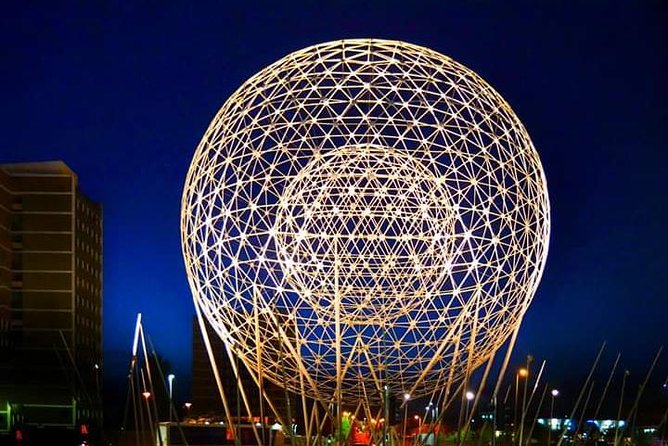
RISE is one of Belfast’s most unusual pieces of public art. The huge metal sphere, created by Wolfgang Buttress, rises 37.5 metres above the Broadway roundabout. Locals have given it less formal names, including The Balls on the Falls and The Westicles.
You get about 10 minutes here, so this is mainly a quick look and photo stop. Its location is useful, though. RISE marks a major gateway into west Belfast, where the tour turns from general city sightseeing toward the conflict’s physical and human scars.
Divis Tower receives around 15 minutes. Built in 1966 as part of a large housing complex, it sits close to the boundary between Falls Road and Shankill Road. During the Troubles, the British Army used the top floors as an observation post, accessible by helicopter during the most dangerous years.
The tower is also linked to the death of Patrick Rooney, a nine-year-old boy killed in 1969, and the shooting of INLA member Emmanuel McClarnon in 1981. These details make Divis more than a piece of concrete housing. They show how ordinary residential buildings became battle points.
This portion can be sobering. I would not choose the tour expecting a lighthearted city overview. The guide’s tone and point of view will shape the experience, so it is worth asking questions and listening for more than one side of the story.
Peace Walls and political murals in west Belfast
The Peace Wall is the emotional center of the outing. These barriers separate mainly nationalist and republican Catholic areas from mainly loyalist and unionist Protestant areas. Some reach up to 25 feet, and gates along them may close at night.
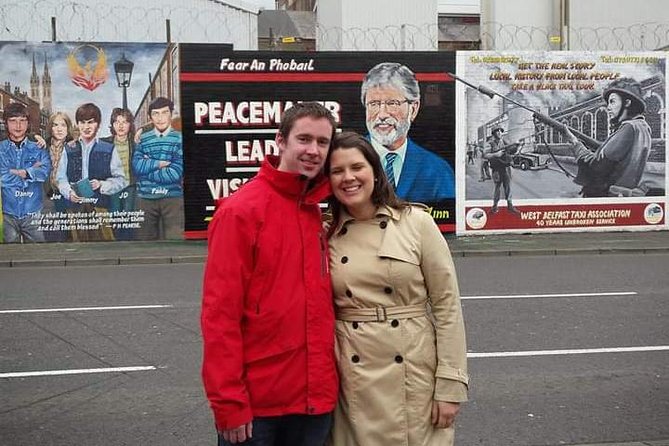
The tour allocates about 30 minutes to the Peace Wall and another 30 minutes to a second Peace Wall entry. The route also includes the International Mural Wall on Divis Street, where political art covers subjects ranging from the Irish hunger strikes to international conflicts and modern political figures.
The wall is not a museum piece. It remains part of the city’s built environment, and that is what makes the stop so powerful. You can sign your name and leave a message of peace and hope, an included part of the experience.
The murals need careful handling. Republican murals often honor the 1981 hunger strike, Bobby Sands, the Easter Rising, or international revolutionary movements. Loyalist murals reflect British identity, unionism, and the memory of those killed on that side. A good guide should explain the symbols without treating one community’s account as the whole story.
One useful point to keep in mind: the city’s peace lines have not simply disappeared since the 1998 Good Friday Agreement. Many remain, especially in north and west Belfast. The tour helps you see the gap between political peace and complete social separation.
A three-star assessment of this kind of experience is understandable if the commentary feels politically one-sided. One account praised a guide’s command of the subject but felt the discussion leaned too strongly toward the IRA. That is not a reason to avoid the tour, but it is a reason to ask direct questions and expect a personal interpretation rather than a neutral classroom lecture.
A completely different sort of day out of Belfast:
- Titanic Belfast Entrance Ticket: Titanic Visitor Experience Including SS Nomadic
★ 4.5 · 3,698 reviews - Cab Tours Belfast Famous Black Taxi Tours
★ 5.0 · 3,633 reviews - A History of Terror – Belfast City Centre Walking Tour
★ 5.0 · 2,883 reviews - Game of Thrones and Giant’s Causeway Full-Day Tour from Belfast
★ 5.0 · 2,291 reviews
St. Peter’s Cathedral and the Bobby Sands mural
St. Peter’s Cathedral on the Falls Road brings a different tone. Built for Belfast’s expanding Catholic population after the Famine, the church opened in 1866, with its twin spires added in 1886.
The Scrabo sandstone exterior and hammer-beam ceiling give the building real presence. It became the cathedral church of the Diocese of Down and Connor in 1986 and is a Grade A listed building. The scheduled visit is about 20 minutes, enough for a meaningful look if the church is open for the planned visit.
The nearby Bobby Sands mural is one of Belfast’s most recognized political images. Sands led the 1981 hunger strike while imprisoned in the Maze and died during it. The mural’s phoenix, broken chain, lark, harp, and cap of liberty all carry republican symbolism.
You get about 10 minutes here, so expect a photo opportunity plus explanation rather than a long stop. The image is striking, but the story is painful and politically charged. A guide who can explain why Sands became such a powerful symbol will add far more than a quick photograph.
The route also includes a second Bobby Sands stop listed for about 20 minutes, along with Clonard Martyrs Memorial Garden and Clonard Monastery. Because some locations appear more than once in the published route, confirm the final order and timing when you book.
Clonard and the Shankill Road divide
Clonard Martyrs Memorial Garden commemorates republican volunteers, civilians, and republican prisoners connected with the area. Its Celtic cross, memorial plaques, black iron gates, and lists of names make the site personal rather than abstract.
The language on the memorial reflects a clear republican viewpoint. That is important to understand before you arrive. You are not looking at a neutral civic monument, but at a community memorial shaped by its own memory of the conflict.
Clonard Monastery offers another angle. During the Belfast Blitz, more than 300 Protestants from the nearby Shankill area hid in its crypt. That detail is a useful reminder that the city’s communities were not always separated by simple, permanent boundaries. Fear and shared danger could also bring people together.
The Shankill Road then presents the loyalist side of west Belfast. The road runs about 2.4 kilometres through a mainly loyalist working-class area. Murals, flags, memorials, and local streets tell a different story from those on the Falls Road.
You have roughly 20 minutes on the Shankill Road. That is enough to absorb the setting and hear an explanation, but not enough for a slow walk through every side street. The value here comes from seeing the two areas in one continuous tour, rather than treating them as unrelated city sights.
Belfast Castle and the city’s grander views
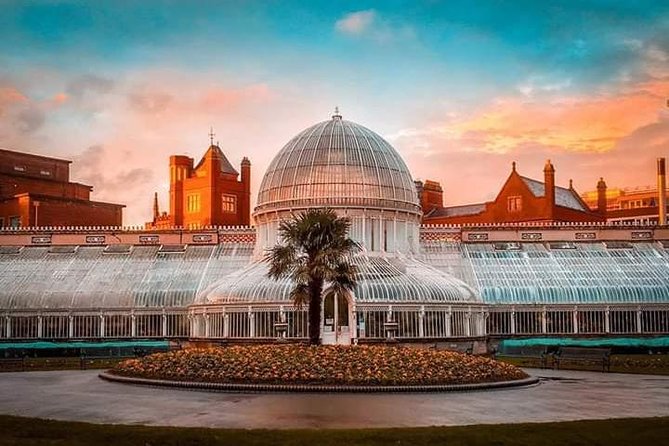
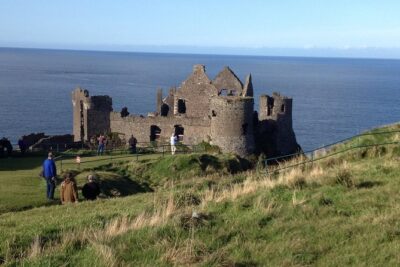
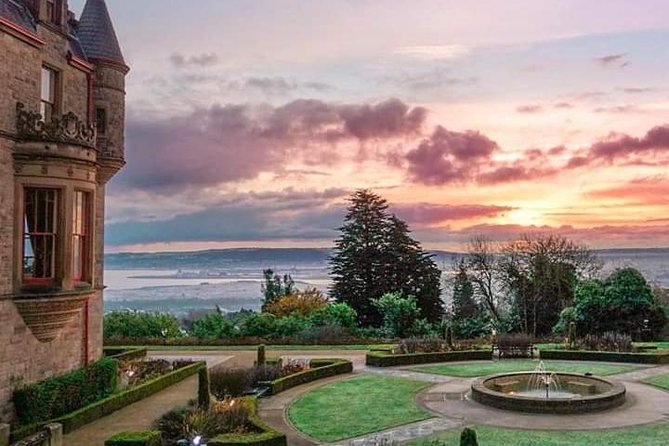
Belfast Castle sits on Cavehill at about 400 feet above sea level. Its position gives you broad views over Belfast and Belfast Lough, a welcome change after the close streets and walls of west Belfast.
The present castle was built between 1811 and 1870 in a Scottish baronial style by Charles Lanyon and his son. Belfast City Council later received the building, and a major refurbishment reopened it to the public in 1988.
The Cat Garden is a playful feature, with nine cats represented in sculptures, mosaics, and shaped shrubs. Local lore also connects the nearby outline of Cavehill, known as Napoleon’s Nose, with Jonathan Swift’s Gulliver’s Travels.
The stop is scheduled for about 30 minutes, but admission is not included. That distinction matters. You may see the exterior, grounds, and views as part of the tour, but ask whether your plan includes entering the building and whether you will pay separately.
City center landmarks: the clock, Big Fish, and Crown Bar
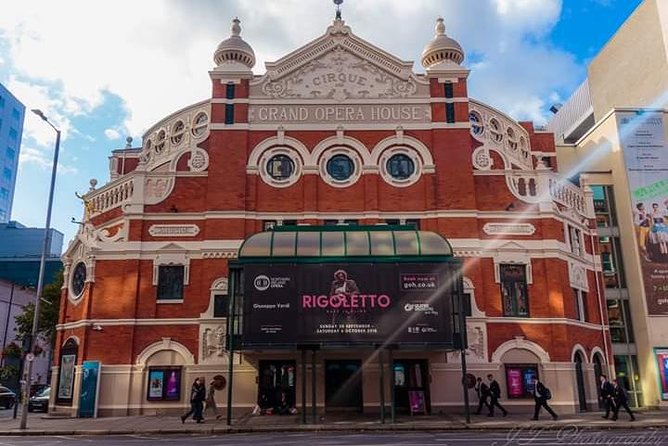
The Albert Memorial Clock gives you a quick look at Belfast’s Victorian civic pride. Built between 1865 and 1869, the 113-foot tower leans about four feet because it was built on wooden piles over reclaimed ground.
Locals joke that it has the time and the inclination. The tower also carries reminders of later conflict, including damage from a 1992 bomb explosion nearby. Ten minutes is enough for photographs and a short explanation.
The Big Fish, or Salmon of Knowledge, is a 10-metre ceramic mosaic beside the River Lagan. Its tiles contain pictures, text, newspaper material, and contributions from Belfast schoolchildren. It also holds a time capsule.
This is one of the route’s most enjoyable small stops. You can walk around it and inspect the individual tiles, each offering a tiny piece of the city’s story. Ten minutes works well here.
The tour ends at the Crown Liquor Saloon, where 30 minutes are included. This Victorian gin palace on Great Victoria Street is one of Belfast’s best-known pubs, with detailed fittings and a strong sense of place. You can quench your thirst there after a serious afternoon, though the price information does not specify whether a drink is included, so plan to pay for your own refreshment.
Titanic Quarter and Belfast’s shipbuilding identity
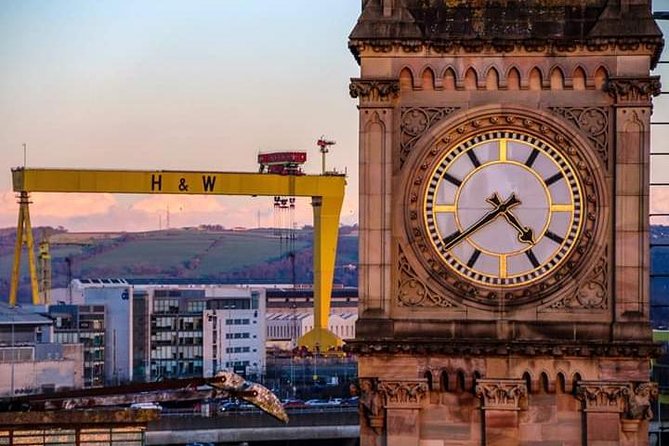
The tour then reaches Belfast’s waterfront and Titanic Quarter. Samson and Goliath, Harland & Wolff’s giant yellow cranes, dominate the skyline. Goliath was completed in 1969 and Samson in 1974, so they did not build the Titanic, despite the common assumption.
The cranes receive about 10 minutes, enough for a photograph and a reminder of Belfast’s industrial scale. Their presence links today’s waterfront to the city’s shipbuilding past.
SS Nomadic is another strong photo stop. Launched in 1911, it carried passengers and mail to RMS Olympic and RMS Titanic. It is the only surviving White Star Line vessel, but admission is not included.
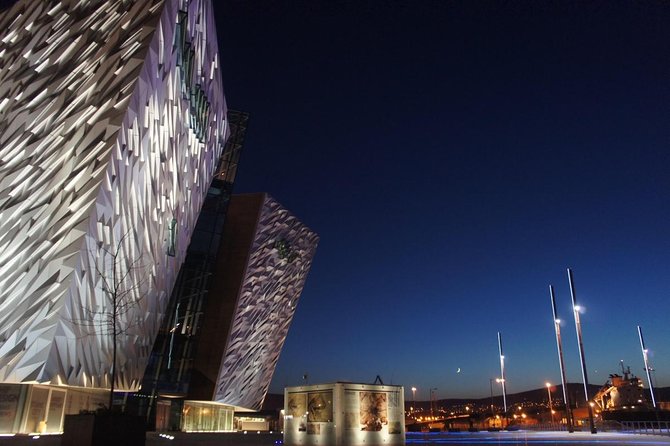
Titanic Belfast also receives about 10 minutes for a photo opportunity, not a museum visit. If the Titanic story is a main reason for coming to Belfast, plan a separate visit. This tour gives you the setting and the exterior, but its short schedule does not allow time to explore the attraction properly.
Price, vehicle, and guide quality
At $638.11 per person, this is an expensive choice. The price pays for a private guide, private transportation, central pickup and drop-off, an air-conditioned vehicle, and the ability to shape the conversation around your group’s interests.
For one or two people, the cost may be hard to defend unless you place a high value on personal history and door-to-door convenience. For a larger private group, the experience may feel more reasonable, but the listed price is still per person, so check the final total carefully.
The strongest part of the experience is the guide. Barry has been praised for explaining Belfast’s past and present with warmth, humor, and personal insight. Joe has also been described as passionate and able to make the conflict feel immediate rather than distant. Those individual guides appear in the feedback, but you should not assume who will lead your departure.
Guide quality is especially important here because the tour deals with competing memories. You will get the most from it if you ask open questions and remain alert to the difference between established facts, community interpretation, and personal experience.
A luxury Mercedes upgrade may be available for £20 when offered. That could appeal if comfort matters to you, but the standard vehicle is described as clean and comfortable, so I would not treat the upgrade as essential.
Who should book this Belfast experience?
I would recommend it to you if you want a fast, private introduction to Belfast and are especially interested in the Troubles, political murals, and the Peace Wall. It is also useful if you have limited time, dislike navigating unfamiliar neighborhoods, or want a guide who can answer sensitive questions.
It suits history-minded visitors more than people seeking a relaxed sightseeing loop. The subject matter is serious, and several locations carry painful memorials. Families with older children may find it educational, but the material should be discussed in advance.
I would not book it if your priority is a full visit to Titanic Belfast, Belfast Castle interiors, or Botanic Gardens at an unhurried pace. You would need separate time for those attractions.
Free cancellation is available up to 24 hours before the start time. Pickup is offered from central Belfast hotels and cruise ships, but not from the airport. Most people can participate, and only your group joins the activity.
Should you book this private Belfast tour?
Book it if you want Belfast’s major sights tied to the city’s living history, and if a private guide is worth the premium. The Peace Wall, Falls Road, Shankill Road, murals, Divis Tower, and memorial sites give you a sharper understanding than sightseeing alone.
Skip it if $638.11 per person feels too steep or if you prefer to spend time inside museums and historic buildings. Before paying, confirm the exact route, who will guide you, how the repeated stops are handled, and how much time is planned at Titanic Belfast and Belfast Castle.
For the right visitor, this is less a standard city tour than a short, intense conversation with Belfast itself.
FAQ
How long does the private Belfast tour last?
The tour lasts approximately 2 hours 40 minutes to 3 hours.
What is the price of the experience?
The listed price is $638.11 per person.
Is hotel pickup included?
Yes. Free pickup and drop-off are offered from central Belfast hotels and cruise ships.
Is airport pickup available?
No. Airport pickup and drop-off are not offered.
Is this a private activity?
Yes. Only your group participates in the tour.
What language is the tour offered in?
The tour is offered in English.
Is transportation included?
Yes. Private transportation in an air-conditioned vehicle is included.
Is admission to every attraction included?
No. Some stops are photo opportunities or exterior visits, and admission to Belfast Castle, SS Nomadic, and Titanic Belfast is not included.
Just added around Belfast
- Belfast City Airport (BHD) to Belfast Accommodation – Arrival Private Transfer★ 5.0 · 3 reviews
- Belfast history of terror & mural 1 hr express private taxi tour★ 5.0 · 3 reviews
- Game of Thrones scene location inc Giants causeway from Belfast★ 5.0 · 3 reviews
- Belfast Private Walking Tour with a Local★ 3.0 · 3 reviews
- Experience the Antrim Coast and the Land of Giants – Private Tour★ 5.0 · 3 reviews
- Giants Causeway Tour From Belfast including Game of thrones sites★ 5.0 · 3 reviews
- Belfast to Dublin Transfer★ 5.0 · 3 reviews
- Private Coast Tour in Belfast★ 5.0 · 3 reviews
Private, compared.
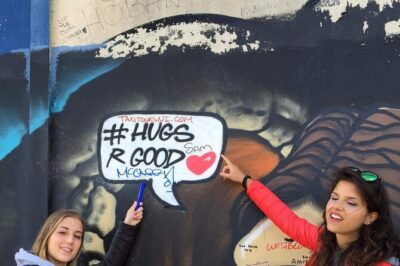
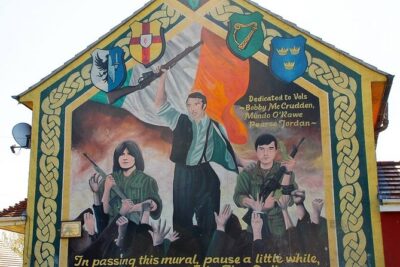
2 Hour Private Belfast Taxi Cab Tour of Troubles & Peace walls
Read our review →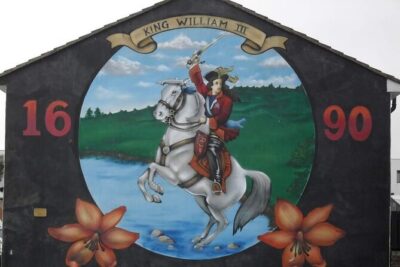
Private Political History & Murals Tour Belfast
Read our review →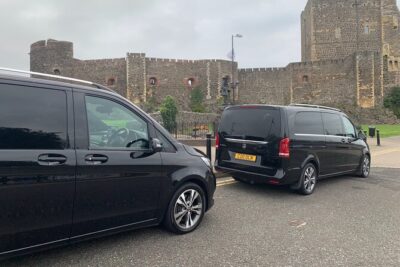
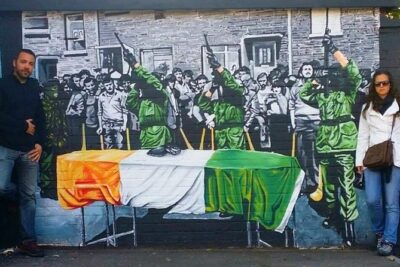
Original Private Belfast Troubles and Peace Cab/Taxi Tour 2 Hours
Read our review →
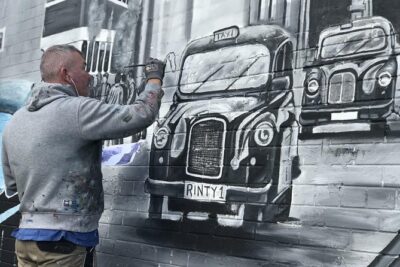
Original Drivers Belfast Taxi/Cab Tour 2 hour private adventure
Read our review →